
Mātai Kōkako Conservation Project
EST 2022
PEST MANAGEMENT
The network was established with significant advice and installation expertise from Lindsay Wilson, and Natasha and Satoshi Yamamoto of WilderNZ. This was uncharted territory for the Maddock Family.
A draft network layout was updated to what we see below, after Lindsay first walked the site, to establish the trapping network. WilderNZ provide ongoing assistance to the project as needed. (Thank you, team!)

The site set-up and ongoing servicing and catch information is managed using the TrapNZ software. The trap lines from TrapNZ are shown in the photograph below.

The property is very steep – there is a 200 metre elevation increase from the lower south-west corner to the higher north-east corner. The perimeter is just over 4 km. Driving out to the north-east corner of the site to cover the perimeter has to be done in 2 tranches due to the track layout. The overall distance here is 10 km.
Where possible, the trap lines are based around tracks on the property and on neighbouring properties (where permission has kindly been given for this access).The approach to the management of pests is as follows:
1. The trapping of larger pests – possums, mustelids and feral cats.2. The poisoning of smaller pests – rodents.
There is crossover, of course, with rodents being killed by both bait and the DoC traps. Possums also are attracted to the rodent bait, and some will meet their demise this way.
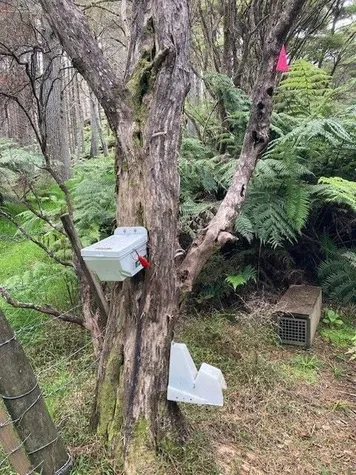
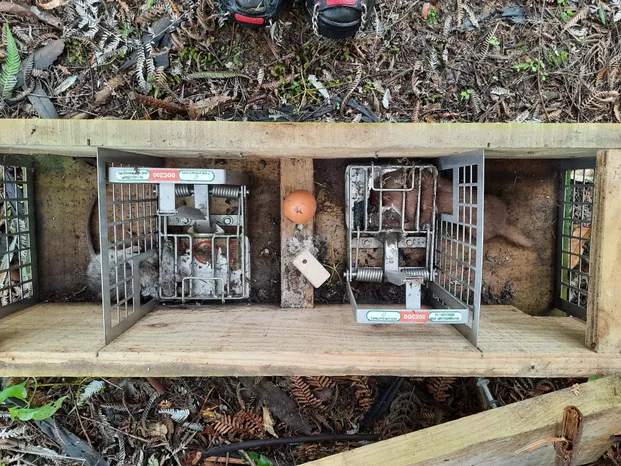
MORE ABOUT OUR PEST MANAGEMENT


| Pest species | Hardware | Bait/ lure (lures are non-toxic attractants) |
|---|---|---|
| Possums | Trapinator (tree mounted trap) | Lure – smooth lure (fruit flavoured) |
| Mustelids | A double-ended DoC trap | Lure – PoaUku block (salty fish block) or dried rabbit |
| Feral cats | Close to base – a cage track Distant from base – Steve Allen cat trap |
Lure – red meat or dried rabbit |
| Rodents | Phil proof bait station Pied Piper rat bait station |
Bait – a 1st generation anticoagulant such as Pindone or D-Block (rotated across each year) |
After getting an initial feel for the seasonal pest activity on the trap lines, the target is for a monthly check of all bait and trap locations across the block. On the more active south-west, north-west, north and northeast sectors of the perimeter line, the target is a weekly check.
In summer, the entire network can be worked and serviced in 3 days. When the tracks are dry, some initial drop off and load carrying work can be completed using a 'side by side' (small 4WD) vehicle.
In winter, the tracks are not passable by vehicles and all servicing work needs to be completed on foot. This extends the time to 4 days. Wet weather never seems to stop in Auckland so foot work happens for a large portion of the year unfortunately, so it keeps the owners busy.
Future developments
The intense baiting and trapping program has been measured to show that low numbers of pests can be maintained within the bush generally. However, this process does not stop the larger mammals coming through the block and damaging the understory and even lush small trees up to about 3 metres in height. Goats and pigs are the main concern. The solution here is perimeter fencing.
The Maddocks are exploring ways to construct a mammal-proof fence around the perimeter of the whole block. This will be something similar to a deer fence. More information will be provided on the progress of fencing in due course. It all comes down to money.